Projects
Dashboards, research projects, and open-source code.
Dashboards
Interactive dashboards that make survey and digital-trace research explorable for the public, journalists, and policymakers.
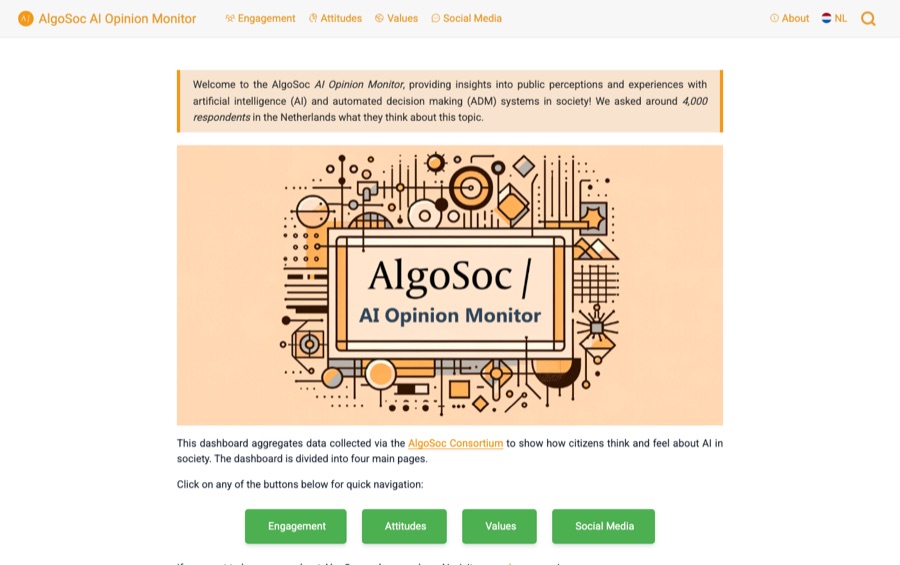
AlgoSoc AI Opinion Monitor
How do people in the Netherlands think and feel about artificial intelligence and automated decision-making? This bilingual dashboard tracks public engagement with, attitudes towards, and values around AI over time.
- ~4,000 respondents per wave, AlgoSoc panel
- Engagement · Attitudes · Values · Social media
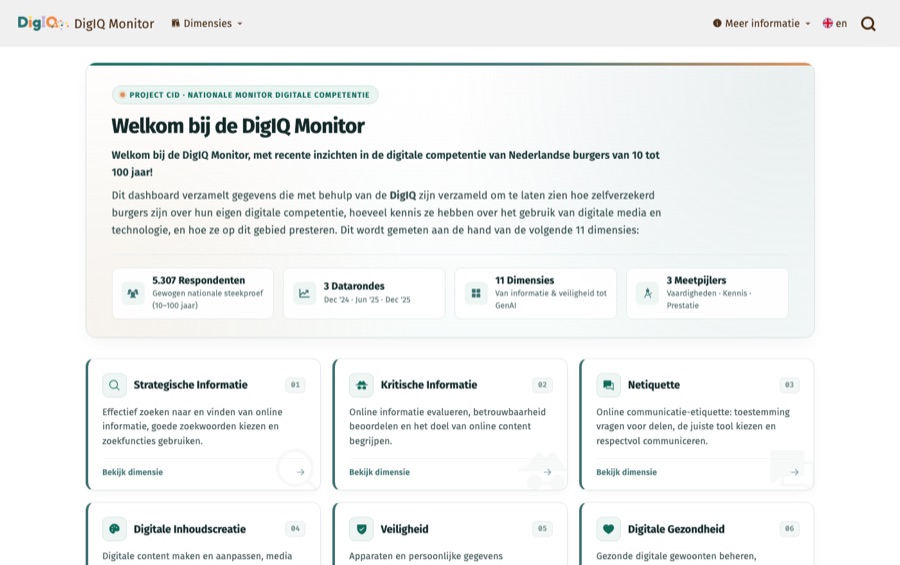
DigIQ Monitor
The national monitor of digital competence: how confident Dutch citizens aged 10 to 100 are in their digital skills, what they know about digital media and technology, and how well they actually perform.
- 5,307 respondents, weighted national sample
- 3 data rounds (Dec 2024 – Dec 2025)
- 11 dimensions, from information skills and safety to generative AI
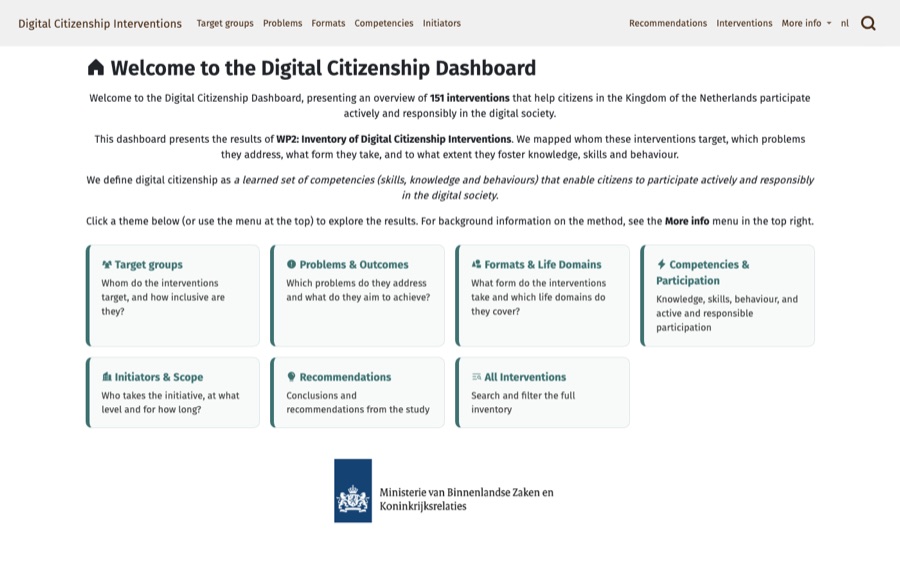
Digital Citizenship Interventions
An inventory of interventions that help citizens across the Kingdom of the Netherlands take part actively and responsibly in digital society, mapping whom they target, which problems they address, and whether they build knowledge, skills, or behaviour.
- 151 interventions, searchable and filterable
- Includes policy recommendations
Research projects
AlgoSoc Longitudinal Effects Panel
A three-year panel study of the Netherlands combining repeated surveys with digital trace data donations from YouTube, Google, Instagram, Facebook and TikTok, to understand the long-term effects of algorithmic platform use and exposure to AI on public opinion.
Are the Kids (AI)right? Algorithmic Curation of Political Material on Youth's Instagram
How Instagram's algorithm curates political search results for Dutch youth, and whether the safety measures of the new "teen accounts" inadvertently limit political socialization.
- Funded by AI & Politics Research Priority Area, University of Amsterdam
How Extremist Content Filters into Mainstream Information Diets
Traces how extremist narratives on Dutch Telegram channels during the COVID-19 pandemic made their way into individual information diets, combining aggregate and individual-level behavioural data that are usually studied in isolation.
- Funded by Conflict & Society Research Priority Area, University of Amsterdam
COVID NORMS
At the University of Zurich, led a paper combining 82 waves of rolling surveys with automated content analysis of news to explain misperceptions of public opinion about COVID-19 measures.
Algorithmic Curation of Political Information by Voice Assistants
Algorithmic audits of voice assistants such as Amazon Alexa when asked for political information and news, with Mykola Makhortykh.
- Funded by Friends of the IKMB, University of Bern
Mobile Information Consumption
Applying a privacy-sensitive image-recognition tool to capture news use inside mobile apps, with Mykola Makhortykh, Aleksandra Urman, and Philipp Krieter.
- Funded by Friends of the IKMB, University of Bern
Open-source code
- dashboardr · R package for building interactive Quarto dashboards (co-developer)
- Distant-Political-Classification · Pipeline that classifies news articles using "distant" labels found in their URLs, cutting manual annotation costs
- Distant_Supervision · Replication code and data for the distant supervision paper, plus example code for training your own models
- electoral_news_sharing_replication · Replication materials for Electoral news sharing (Information, Communication & Society)